
Table of Contents
On July 19, 2024, a major incident erupted in the tech world when cybersecurity firm CrowdStrike accidentally released a faulty software update that caused countless Windows machines across the globe to crash, showing the dreaded “blue screen of death.” This glitch disrupted critical services everywhere from airlines and airports to hospitals and banks and hit roughly 8.5 million devices, making it one of the largest IT outages in history. The fallout was staggering flights delayed or grounded, surgeries paused, business operations halted, and chaos across global industries. Analysts put the financial cost in the billions, with one insurer estimating around $5.4 billion in losses among Fortune 500 firms.
What Exactly Happened?
CrowdStrike distributes a program called Falcon Sensor, which safeguards computers by scanning for threats. On July 19 they pushed out an update that included a flawed file due to a breakdown in their quality check process which bypassed validation and ended up deployed worldwide. Within 90 minutes, millions of systems crashed. CrowdStrike acted fast to pull back the update and release a fix, but damage had already been done.
That breakdown not only stopped computers from working but also meant everyday life ground to a halt air traffic control, hospital systems, broadcast stations, even gas pumps and ticket machines were affected .
On July 24, five days after the outage began, CrowdStrike’s CEO George Kurtz issued a public apology and acknowledged, “Nothing is more important to me than the trust and confidence that our customers and partners have put into CrowdStrike”. The company also shared a Preliminary Post Incident Review, explaining the quality control bug and promising improvements like slowing down future update rollouts and giving clients more control over when updates happen.
Responding to the Chaos
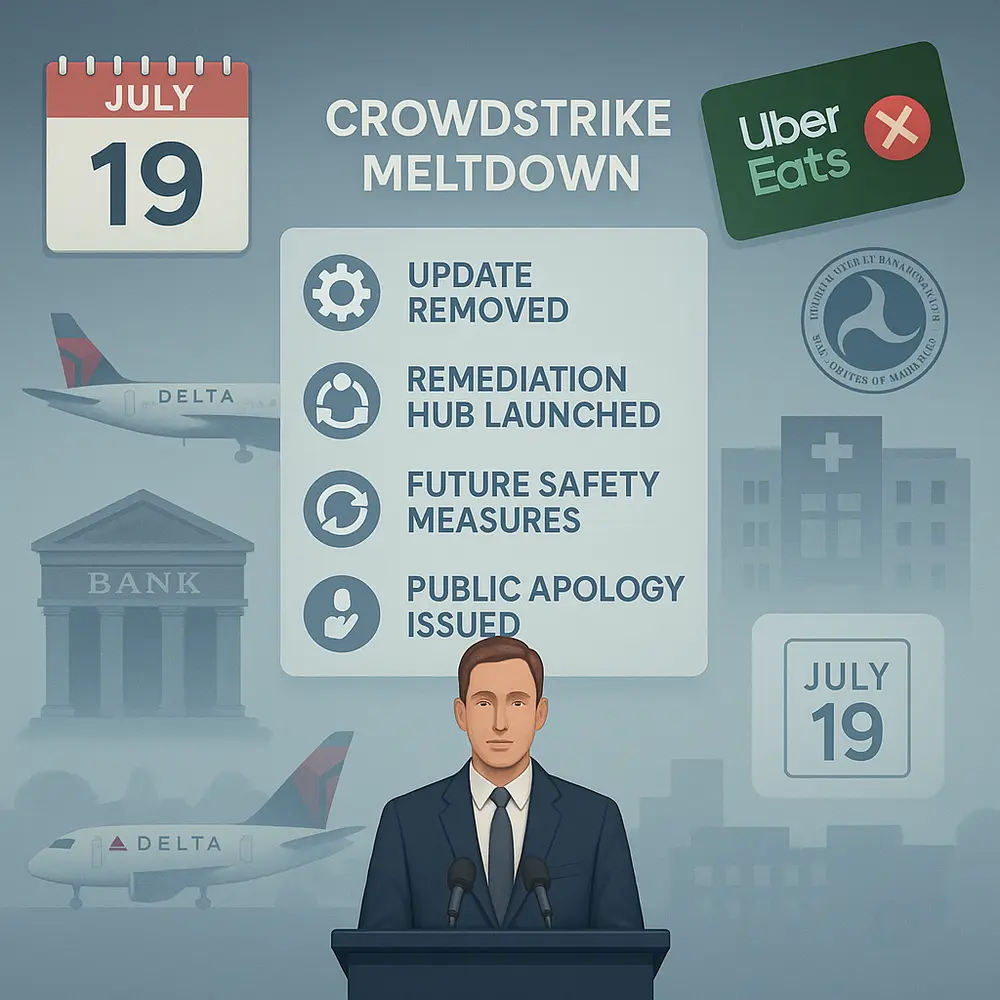
CrowdStrike launched a multi pronged response strategy after the meltdown:
- Removed the faulty update immediately and issued a corrected one
- Offered guidance and tools via a “Remediation Hub” to help IT teams restore systems quickly
- Laid out future safety measures, such as staged deployments and clearer update notifications
- Publicly apologized through its leaders including CEO Kurtz and CSO Shawn Henry admitting the damage was significant and vowing transparency.
- Some high profile companies like Delta Airlines and Air France KLM reported steep impacts, with Delta canceling over 6,000 flights. The U.S. Department of Transportation even opened an investigation to understand passenger rights following the disruptions.
- In addition to immediate fixes, there was a broader conversation about future safeguards to prevent similar global scale failures in cybersecurity tools.
The Uber Eats Voucher
In a bid to thank the hard working system administrators, security partners, and IT professionals working overtime to stabilize things, CrowdStrike offered $10 Uber Eats gift cards covering a coffee, snack, or lunch. An email signed by Chief Business Officer Daniel Bernard explained, “We recognize the additional work that the July 19 incident has caused. And for that, we send our heartfelt thanks and apologies. To express our gratitude, your next cup of coffee or late-night snack is on us!”
It’s important to clarify that these vouchers were offered only to internal staff, contractors, and channel partners in the CrowdStrike Accelerate Program not to customers or the general public.
Why Uber Flagged the Gift Cards?
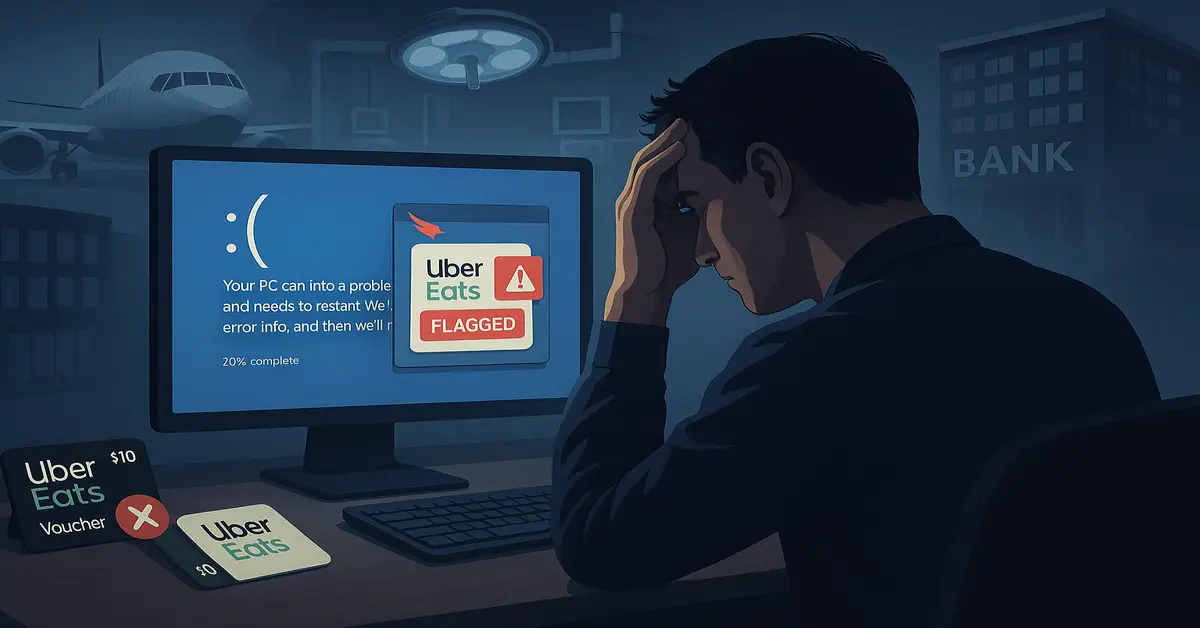
Soon after being distributed, many recipients reported their vouchers were declined. Uber had flagged them as potential fraud, likely due to the unusually high volume redeemed in a short time an automated policy designed to spot suspicious behavior. One user got a message saying the voucher was “canceled by the issuing party and is no longer valid”. In some cases, CrowdStrike resent vouchers after the blockage was lifted
This raised several issues:
- High volume triggers: Automated systems might mistake valid mass issuances as fraud
- Lack of coordination: CrowdStrike didn’t appear to notify Uber ahead of time
- Temporary frustration: Recipients felt the gesture fell flat when the vouchers failed
Public Reaction
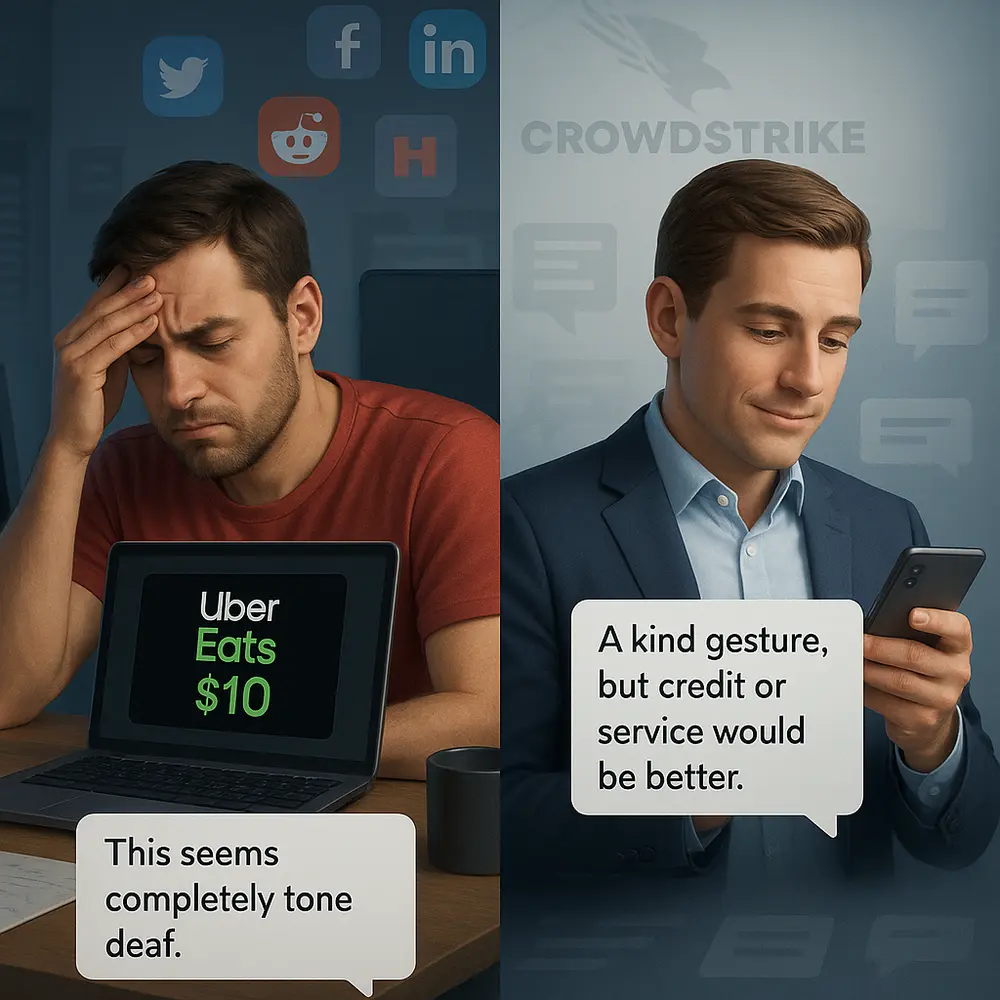
Social media buzzed with mixed reactions. Many IT professionals who worked long hours felt underappreciated, calling the $10 voucher tone deaf given the scale of the outage. One commenter on Hacker News wrote “A $10 gift card after messing up millions of devices. this seems completely tone deaf. It’s like crashing someone’s car and giving them a bag of Skittles for the trouble”.
On the other hand, some defended the gesture as a small but sincere attempt to say “thank you.” One partner on LinkedIn admitted they still valued CrowdStrike, but suggested free services or a longer credit might have been more appropriate.
Bigger Lessons Learned
This incident carries clarity for the tech and security world:
1. Even trusted cybersecurity tools can fail
Security products operate deeply within systems and any flaw in them can cause massive disruption.
2. Quality control matters
A single unchecked validation step let faulty data spread globally. The cost of oversight was enormous.
3. Transparency builds trust
CrowdStrike’s decision to issue public reviews and apologies showed accountability, even if the initial gesture fell short.
4. Gesture versus recompense
A $10 coffee voucher may not match the scale of disruption. Monetary refunds, free services, or extended support might better reflect the harm.
5. Communicate with partners
Sending such tokens at scale needs coordination with vendors like Uber to avoid fraud trigger woes.
6. Use staggered rollouts
CrowdStrike’s move to roll out future updates in stages echoes a broader industry shift toward safer deployment strategies
Timeline Summary
Here’s a clear timeline of what happened:
| Date | Event |
| July 19 | Faulty Falcon Sensor update deployed, crashes begin |
| July 19 to 23 | Global impact on businesses, hospitals, airports |
| July 20 | CloudStrike halts update and starts manual remediation |
| July 24 | Public apologies, technical reports published |
| July 24 | $10 Uber Eats voucher emailed to partners |
| July 24 to 25 | Uber flags gift cards as fraud; vouchers canceled/resent |
| July 26+ | CrowdStrike implements staggered update plan |
Frequently Asked Questions (FAQ)
1. Why did Crowd Strike send Uber Eats gift cards?
Crowd Strike sent $10 Uber Eats vouchers to thank internal staff, partners, and contractors who worked extra hours during the July 19 global outage. It was meant as a small gesture of appreciation, not as compensation to customers or the public.
2.Why did Uber’s system block the gift cards?
Uber’s system automatically flagged the bulk delivery of gift cards as possible fraud due to the high number of redemptions in a short time. This led to some cards being canceled or marked as invalid temporarily until Crowd Strike reissued them.
3. Will customers be compensated for the outage?
As of now, Crowd Strike has not offered financial compensation to end customers. Instead, the company is focusing on fixing the problem, improving its update process, and helping IT teams restore services through technical support and tools.
4. Who received the Uber Eats gift cards?
The gift cards were given only to CrowdStrike’s internal teams, contractors, and official business partners who were directly involved in recovery efforts. Regular customers and the general public did not receive these vouchers.
Final Take
The CrowdStrike outage was historic millions of machines affected, billions in damages, and major economic disruption across critical industries. The $10 Uber Eats vouchers were a well meaning but underwhelming gesture for a situation of such reach. While gratitude is important, support should match the scale of impact. Still, CrowdStrike’s willingness to examine causes, apologize openly, and improve systems offers a hopeful path for the future. In tech, even heroes can stumble and how you respond matters most.